
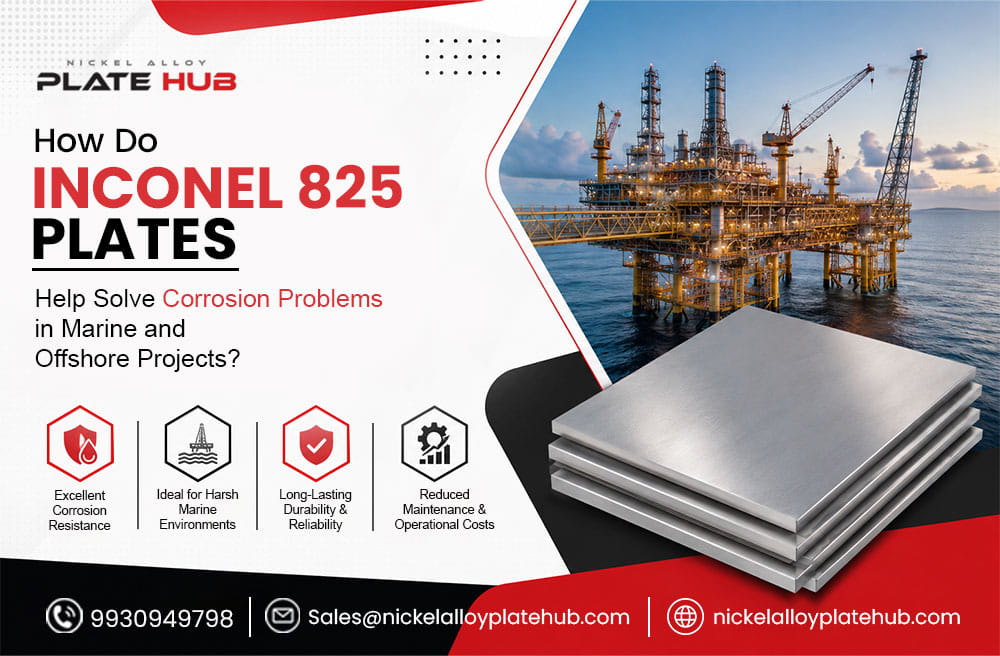
Marine and offshore industries operate in some of the world’s harshest environments. Constant exposure to saltwater, humidity, chlorides, acidic chemicals, and fluctuating temperatures can quickly degrade conventional metals, leading to equipment failure, increased maintenance costs, and operational downtime. To overcome these challenges, industries increasingly rely on high-performance nickel alloys that deliver exceptional corrosion resistance and mechanical strength.
Among these advanced materials, Inconel 825 plates have emerged as a preferred choice for offshore platforms, marine structures, desalination plants, and chemical processing systems.
Although many engineers also evaluate Inconel 625 plate applications for demanding environments, Inconel 825 offers an outstanding balance of corrosion resistance, fabrication ease, and cost-effectiveness, making it one of the most trusted offshore alloys available today.
In this guide, we at Nickel Alloy Plate Hub explore how Inconel 825 plates help solve corrosion problems and why they continue to be an essential material for marine engineering.
What Are Inconel 825 Plates?
Inconel 825 is a nickel-iron-chromium alloy enhanced with molybdenum, copper, and titanium. This carefully engineered composition provides exceptional resistance against both oxidizing and reducing acids while maintaining excellent strength in aggressive marine environments.
Unlike conventional stainless steel, Inconel 825 withstands prolonged exposure to chloride-rich seawater without suffering from localized corrosion or stress corrosion cracking.
Typical Chemical Composition
- Nickel (38–46%)
- Chromium (19.5–23.5%)
- Iron (Balance)
- Molybdenum
- Copper
- Titanium
These alloying elements work together to provide superior durability in corrosive industrial applications.
Why Do Marine Environments Cause Severe Corrosion?
Marine structures constantly encounter:
- Saltwater immersion
- Chloride attack
- High humidity
- Oxygen-rich seawater
- Biological fouling
- Sulfur compounds
- Acidic cleaning chemicals
Traditional carbon steel develops rust rapidly, while many stainless steels become vulnerable to pitting corrosion after prolonged chloride exposure.
This is where premium offshore alloys like Inconel 825 outperform conventional engineering materials.
How Inconel 825 Plates Solve Marine Corrosion Problems
1. Exceptional Resistance to Chloride-Induced Corrosion
Seawater contains high concentrations of chloride ions that aggressively attack ordinary metals.
Inconel 825 provides outstanding protection against:
- Chloride pitting
- Crevice corrosion
- Stress corrosion cracking
- Surface degradation
This significantly extends the service life of offshore equipment.
2. Excellent Performance in Acidic Environments
Offshore oil and gas production often exposes materials to:
- Sulfuric acid
- Phosphoric acid
- Nitric acid
- Organic acids
The addition of copper and molybdenum enables Inconel 825 plates to resist both oxidizing and reducing acids, making them ideal for chemical handling systems.
3. High Resistance to Stress Corrosion Cracking
Stress corrosion cracking is one of the leading causes of failure in offshore components.
Inconel 825 offers excellent resistance even when exposed to:
- High mechanical loads
- Chloride-rich seawater
- Elevated temperatures
This improves operational reliability and minimizes unexpected shutdowns.
4. Superior Mechanical Strength
Marine structures experience:
- Heavy wave impact
- Wind loading
- Pressure fluctuations
- Mechanical vibration
Inconel 825 retains its mechanical properties even under extreme operating conditions, ensuring structural integrity over long service periods.
5. Outstanding Weldability
Large offshore installations require extensive fabrication and welding.
Inconel 825 plates offer:
- Easy fabrication
- Excellent weldability
- Reduced post-weld cracking
- Consistent corrosion resistance across welded joints
This lowers fabrication costs while maintaining long-term performance.
Marine and Offshore Applications of Inconel 825 Plates
Although engineers frequently compare Inconel 625 plate applications, Inconel 825 is widely selected for projects where exceptional corrosion resistance is the primary requirement.
Common applications include:
- Offshore oil drilling platforms
- Seawater piping systems
- Heat exchangers
- Pressure vessels
- Marine exhaust systems
- Desalination plants
- Chemical storage tanks
- Offshore structural supports
- Pump components
- Flue gas desulfurization systems
These demanding applications demonstrate why Inconel 825 remains one of the industry’s most dependable offshore alloys.
Inconel 825 vs Conventional Stainless Steel
| Property | Inconel 825 | Stainless Steel |
| Chloride Resistance | Excellent | Moderate |
| Pitting Resistance | Excellent | Limited |
| Acid Resistance | Outstanding | Moderate |
| Stress Corrosion Cracking | Excellent | Susceptible |
| Marine Durability | Very High | Medium |
| Service Life | Long | Shorter |
Although stainless steel performs well in many industrial environments, Inconel 825 offers significantly greater reliability for offshore projects.
Inconel 825 vs Inconel 625 Plate Applications
Many buyers compare Inconel 825 with Inconel 625 plate applications before selecting a material.
Inconel 825 is preferred for:
- Chemical processing
- Acid handling
- Marine corrosion protection
- Desalination plants
- Sulfuric acid environments
Inconel 625 is commonly selected for:
- High-temperature service
- Aerospace components
- Turbine systems
- Marine exhaust equipment
- Heavy structural applications
Both materials are excellent offshore alloys, but the selection depends on temperature, corrosion conditions, and mechanical loading.
Benefits of Choosing Inconel 825 Plates
Key advantages include:
- Exceptional corrosion resistance
- Long service life
- Reduced maintenance
- Lower lifecycle costs
- Excellent fabrication characteristics
- Outstanding toughness
- High fatigue resistance
- Strong oxidation resistance
- Reliable performance in seawater
- Excellent resistance to aggressive chemicals
These advantages make Inconel 825 an economical long-term investment despite its higher initial cost.
Why Do Offshore Industries Prefer Nickel Alloys?
The offshore sector cannot afford unexpected equipment failures. Every shutdown results in costly production losses and safety risks.
Premium nickel-based offshore alloys deliver:
- Increased operational reliability
- Reduced maintenance intervals
- Improved worker safety
- Lower replacement costs
- Greater resistance to harsh marine environments
For this reason, industries worldwide continue investing in advanced nickel alloys such as Inconel 825 and evaluating Inconel 625 plate applications where higher temperature resistance is required.
Corrosion remains one of the greatest challenges facing marine and offshore industries. Selecting the right material directly impacts operational efficiency, equipment lifespan, and maintenance costs.
Inconel 825 plates provide an ideal solution by combining exceptional resistance to seawater corrosion, acids, chloride attack, and stress corrosion cracking. Their outstanding weldability, durability, and long-term reliability make them indispensable in offshore platforms, desalination plants, chemical processing units, and marine infrastructure.
While Inconel 625 plate applications remain popular for high-temperature operations, Inconel 825 continues to be one of the most trusted offshore alloys for combating corrosion in aggressive marine environments. Investing in Inconel 825 plates ensures superior performance, lower lifecycle costs, and dependable operation even in the world’s harshest offshore conditions.
To buy Inconel 825 Plates of Premium Quality at an affordable Inconel 825 Plates Price in India, ‘Get in Touch’ with Nickel Alloy Plate Hub.
1. Why are Inconel 825 plates used in marine applications?
Inconel 825 plates provide excellent resistance to seawater corrosion, chloride attack, pitting, and stress corrosion cracking, making them ideal for marine and offshore environments.
2. What are common Inconel 625 plate applications?
Inconel 625 plate applications include offshore platforms, marine exhaust systems, heat exchangers, aerospace components, pressure vessels, and chemical processing equipment.
3. Are Inconel 825 plates suitable for offshore oil and gas projects?
Yes. Their superior corrosion resistance, mechanical strength, and durability make them an excellent choice for offshore drilling platforms, subsea equipment, and seawater handling systems.
4. What makes nickel-based offshore alloys better than stainless steel?
Nickel-based offshore alloys offer greater resistance to chlorides, acids, pitting, crevice corrosion, and stress corrosion cracking, resulting in longer service life and reduced maintenance.
5. How long do Inconel 825 plates last in marine environments?
With proper design and maintenance, Inconel 825 plates can provide decades of reliable service in aggressive marine and offshore environments, significantly outperforming conventional stainless steel.