
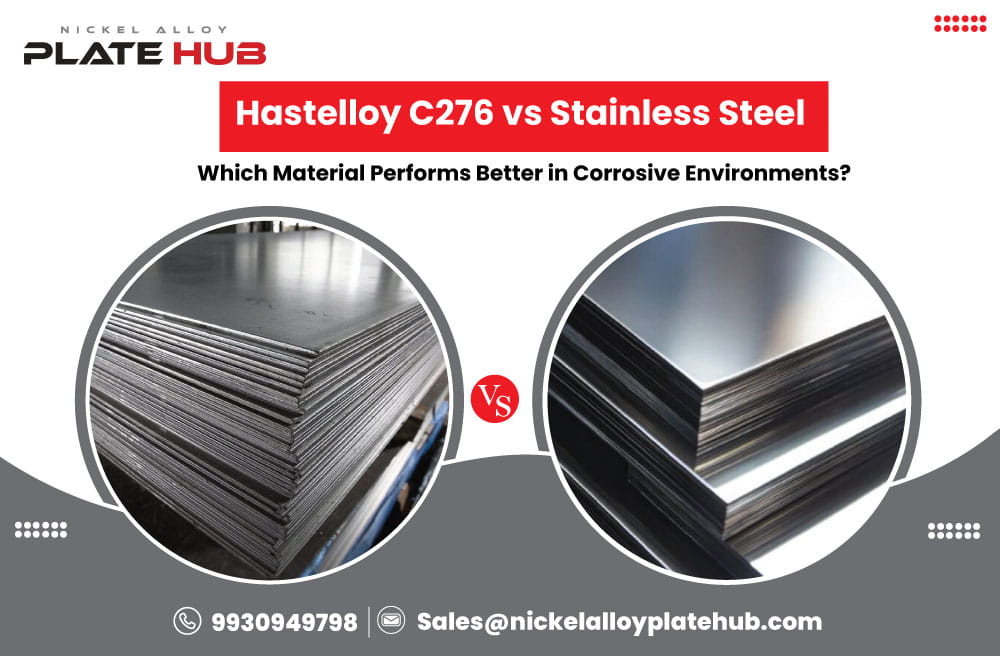
Industrial equipment that is used in harsh marine, chemical, offshore, and high-temperature environments requires substances that are resistant to corrosion, while also maintaining the strength of the machine. Selecting the wrong material can result in premature failure of equipment or costly downtime, as well as higher maintenance costs.
The most popular discussions among procurement experts as well as makers are Hastelloy against Stainless Steel. While stainless steel is acknowledged for its cost-effectiveness and flexibility, Hastelloy C276 is specially designed to stand up to some of the most extreme corrosive environments that are found in the modern industrial sector.
For these metal alloys for industrial use, we at Nickel Alloy Plate Hub shall analyze the two alloys based on mechanical properties, resistance to corrosion, fabrication, cost, in addition to industrial use, and use a Hastelloy vs Stainless Steel comparison to determine which is more durable over time.
Understanding Hastelloy C276
Hastelloy C276 is a nickel-molybdenum-chromium alloy with tungsten additions. It was created to offer outstanding resistance to both oxidizing and decreasing conditions.
Chemically, it is one of the most durable materials that are resistant to corrosion and is in a position to handle:
- Mineral acids with strong strength
- Chlorides
- Sulfuric acid
- Hydrochloric acid
- Phosphoric acid
- Wet chlorine gas
- Seawater
- Chemical solvents
In contrast to many stainless steels, Hastelloy C276 can maintain excellent corrosion resistance when welding.
Understanding Stainless Steel
The term “Stainless Steel” refers to an iron-based alloy with at minimum 10.5 percent chromium. Different grades like 304 or 316, 310 as well as Duplex Stainless Steel serve different industrial applications.
Its chromium content creates an oxide layer that protects the material from weathering and minor chemical exposure.
The stainless steel is among the most cost-effective engineering materials due to the following reasons:
- Excellent availability
- Good mechanical strength
- A beautiful finish
- Fabrication is easy
- Competitive pricing
However, the resistance to corrosion differs greatly based on the quality and conditions.
Hastelloy vs Stainless Steel: Composition Comparison
| Property | Hastelloy C276 | Stainless Steel 316 |
| Base Metal | Nickel | Iron |
| Chromium | 15-17% | 16-18% |
| Nickel | Balance (~57%) | 10-14% |
| Molybdenum | 15-17% | 2-3% |
| Iron | Small amount | Balance |
The much higher molybdenum and nickel-based content of Hastelloy C276 gives it better resistance to corrosion.
Corrosion Resistance Comparison
Corrosion resistance is the area in which Hastelloy C276 is clearly distinguished from other alloys. We at Nickel Alloy Plate Hub offer you an industrial alloy comparison below:
Hastelloy C276
Hastelloy is extremely effective in:
- Chloride-rich areas
- Strong acids
- Marine applications
- Oxidizing chemicals
- Reducing chemicals
- Crevice corrosion
- Stress corrosion cracks
- Pitting corrosion
It is solid even in extremely destructive chemical processing facilities.
Stainless Steel
Standard stainless steel is effective in:
- Fresh water
- Food processing
- Industries in the field of pharmaceuticals
- Architectural applications
- Mild chemicals
However, exposure to chlorides or concentrated acids may cause:
- Pitting
- Crevice corrosion
- Cracking in stress corrosion of Chloride
- Surface deterioration
When you are comparing Hastelloy against Stainless Steel, Hastelloy is the best choice for extremely corrosive environments.
Mechanical Properties
Both materials have great mechanical toughness.
Hastelloy C276
- Tensile strength high
- Super durability
- Good ductility
- Stability of high temperatures
- Excellent fatigue resistance
Stainless Steel
- High-strength
- Good durability
- Excellent impact resistance
- Simple cold working
- Moderate high-temperature performance
For industrial applications that require a lot of use of aggressive chemicals and thermal cycling, Hastelloy offers greater reliability.
Temperature Performance
The industrial process often exposes equipment to high temperatures.
Hastelloy C276
Exquisite in:
- Heat exchangers
- Chemical reactors
- Incinerators
- Flue gas scrubbers
Its resistance to corrosion remains strong even at temperatures that are higher than normal operating temperatures.
Stainless Steel
Many grades lose the ability to resist corrosion in the presence of:
- Continuously high heat
- Chloride-rich environments
- Thermal cycling
The stainless grades that are heat-resistant are available, but they are not able to compete with Hastelloy C276 when exposed to extreme chemical conditions.
Weldability and Fabrication
One benefit shared by the two materials is an excellent ability to fabricate.
Hastelloy C276
- We can easily join them.
- Good formability
- Excellent machining when using the correct tool
- Welds maintain resistance to corrosion
Stainless Steel
- It is easy to weld
- Excellent machining
- Available immediately
- Lower cost of fabrication
It is usually easier and cheaper to make into the final products.
Cost Comparison
Cost is still an important element.
Stainless Steel
Advantages:
- Cost of materials is low.
- Lower costs for machining
- Worldwide, it is readily available.
- Affordable replacement
Hastelloy C276
Costs are higher due to:
- High nickel content
- Specialized manufacturing
- Premium corrosion-resistant materials
- Limited availability
While Hastelloy is more expensive to purchase at a higher price, its long service duration often reduces the total cost of life through a reduction in maintenance time, downtime, and the frequency of replacement.
Industrial Applications
Hastelloy C276 Applications
- Chemical processing plants
- Industries of the Petrochemical
- Equipment for controlling pollution
- Offshore oil & gas
- Marine engineering
- Manufacturing of pharmaceuticals
- Waste treatment facilities
- Desulfurization systems
Stainless Steel Applications
- Food processing
- Equipment for dairy production
- Kitchen equipment
- Construction
- Automotive components
- Treatment of water
- Architectural structures
- Medical devices
The decision to choose between them depends mostly on the operating conditions, instead of the initial material cost.
Which Material Should You Choose?
You must conduct an industrial alloy comparison before selecting the right alloy for your requirement.
Choose Hastelloy C276 if your application involves:
- Aggressive acids
- Chlorides
- Seawater
- High temperatures
- Offshore environments
- Chemical reactors
- Corrosive process equipment
Select stainless steel for your project if it needs:
- Fabrication cost-effective
- Moderate corrosion resistance
- Food-grade products
- Decorated finishes
- General engineering
- Indoor industrial use
In the battle of Hastelloy and Stainless Steel, there is no one winner, but only the best material for the appropriate application.
For harsh environments: For extremely corrosive environments, Hastelloy C276 provides unbeatable performance, outstanding endurance, and considerably longer life span. Its resistance to chlorine pitting, strong acidic crevice corrosion, and cracking caused by stress is one of the most reliable corrosion-resistant materials.
However, stainless steel is the most preferred choice in general industrial applications, where exposure to corrosion is minimal, and budget considerations are essential.
For those who want maximum security in the harsh chemical processing environment, this industry-specific alloy review shows clearly that Hastelloy C276 provides superior value over the long term despite the higher initial cost.
1. Which is superior: Hastelloy C276 or Stainless Steel?
Hastelloy C276 excels in environments that are extremely corrosive, such as chlorine, acids, and seawater. Stainless steel is suitable for moderate resistance to corrosion as well as efficient industrial applications.
2. What makes Hastelloy more resistant to corrosion than stainless steel?
Hastelloy contains significant amounts of molybdenum and nickel, making it resistant to the effects of pitting and crevice corrosion cracking from stress corrosion, as well as an aggressive chemical attack much superior to the majority of stainless steel grades.
3. Is Hastelloy C276 really worth more?
Yes. While Hastelloy C276 has the highest initial price, it is extremely durable with lower maintenance requirements and a longer life span, often resulting in lower cost of life.
4. Does Stainless Steel replace Hastelloy in Chemical processing plants?
Only for applications that involve mild chemicals. For chlorides, strong acids, and media that are highly corrosive, Hastelloy C276 is still the most secure and safe material option.
5. What industries typically make use of Hastelloy C276?
Hastelloy C276 is extensively used for chemical processes, petroleum plants, marine engineering, offshore oil and gas production, pharmaceutical manufacturing, pollutant control, as well as wastewater treatment facilities where high corrosion resistance is crucial.